Why Stucco Chalks & Fades in Reno, NV | South Reno Repaint
A South Reno gated community home had chalking, faded dark stucco. Here is what causes it at 4,500 feet, the prep that makes a repaint last, and what the job cost.
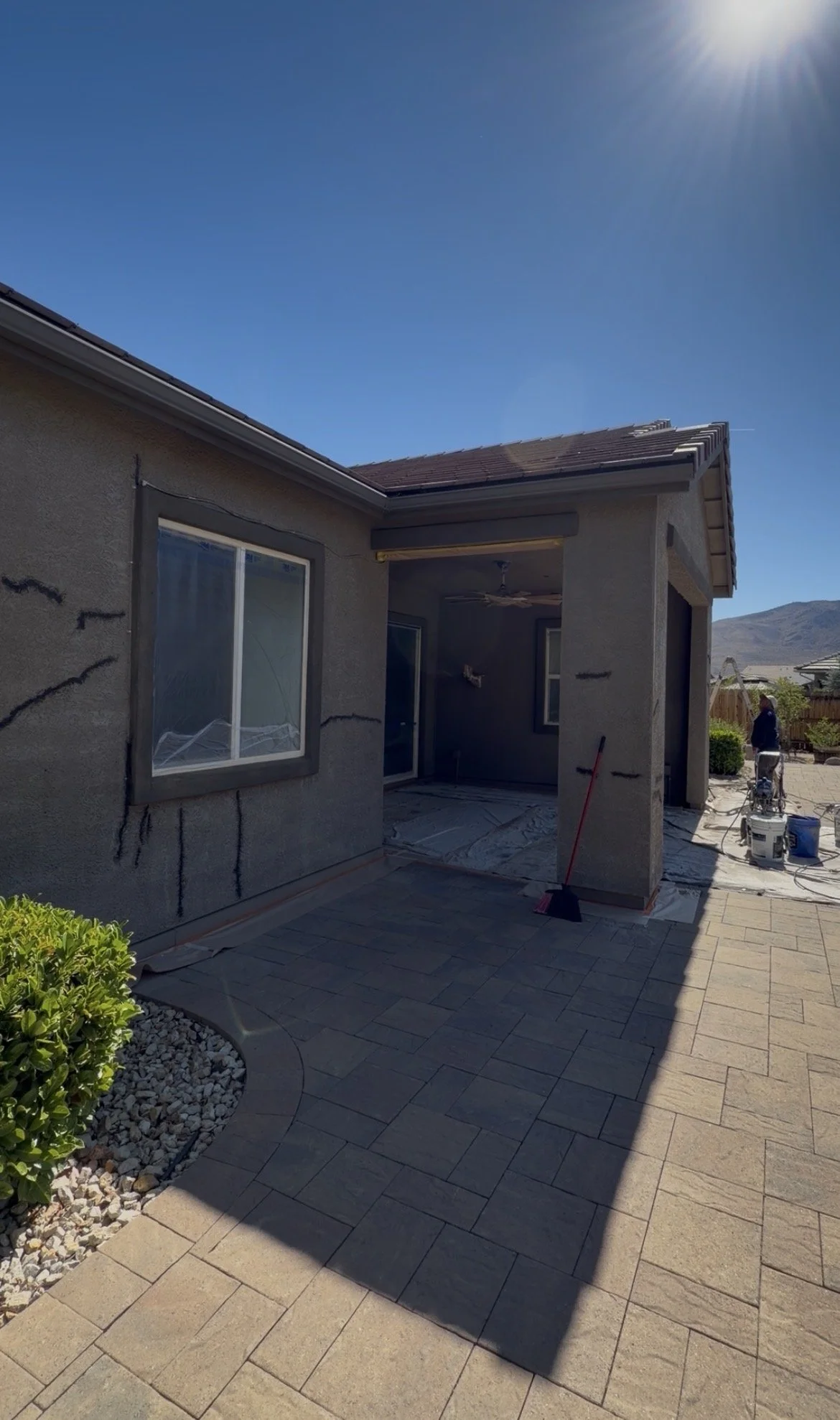
Stucco home in South Reno getting dialed in before paint: windows masked, cracks patched, floor protected, furniture covered.
A homeowner in a gated community in South Reno, 89521, called us about his stucco. From the street the house looked tired. Up close it was worse. Run a hand across the wall and it came back covered in a fine dusty film the color of the house. The dark body color had gone flat and blotchy, worst on the south and west walls.
That dust has a name. It is chalking, and it is the most common failure we find on dark stucco in South Reno.
What chalking actually is
Paint is pigment held in place by a binder, which is essentially the glue of the paint film. Ultraviolet light attacks that binder. As it breaks down, the pigment it was holding lets go and sits loose on the surface as powder.
Two things follow. The color looks washed out, because you are looking at loose pigment instead of an intact film. And the wall has effectively become non-stick. Chalk is a bond breaker. Anyone who rolls fresh paint straight over a chalked wall is bonding the new coat to loose powder, and it will come off in sheets within a few seasons. Most of the peeling repaints we get called out to fix started exactly that way.
Why South Reno is hard on dark stucco
Three things stack up here.
Elevation. Reno sits at roughly 4,500 feet, and much of South Reno sits higher. UV intensity increases about 4 percent for every 1,000 feet of elevation, which puts our walls under roughly 18 to 20 percent more UV than the same house at sea level. Same sun, more of what actually destroys paint.
Heat absorption. Behr's own guidance to painting contractors says it plainly: lighter colors last longer and fade less than darker colors, because dark colors absorb more sunlight and that accelerates fading. On a west-facing wall in July, surface temperature runs far above air temperature, and that heat cycling works the film hard.
Pigment chemistry. Inorganic pigments, meaning beiges, tans, browns and earth tones, hold up considerably better than the organic pigments that produce rich blues, greens, reds and deep saturated colors. That is chemistry, not a style opinion, and it explains why two houses painted the same year can be in completely different shape.
Add our swing from 95 in the afternoon to 50 overnight, with stucco expanding and contracting through it, and a dark exterior in South Reno is simply working harder than one in a milder climate.
What we found on this house
Heavy, uniform chalking across the stucco field, worst on south and west exposures
Visible fade and blotchiness in the dark body color
Hairline and settlement cracking in the stucco
Failed and separated caulk at windows, doors and penetrations
Wood trim, fascia and garage doors in worse shape than the stucco, which is typical, since wood and metal fail on a different schedule
The prep is the job
Homeowners compare bids on the paint. Painters know the repaint lives or dies on prep.
Pressure washing to remove the chalk. Not a rinse. The goal is a sound, non-powdery surface. We test it the same way you can: wipe a dark cloth across the dry wall. If it comes back loaded, it is not ready for paint.
Stucco crack repair and patching. Cracks filled with the correct masonry patching material, and every patch textured to match the surrounding stucco. A patch you can see from the driveway is a failed patch.
Caulking and sealing. Windows, doors, trim junctions and every penetration. This is water management as much as appearance. Open joints in Reno mean freeze-thaw damage over the winter.
Trim, fascia and garage doors. Different substrates, different prep. Scraping, sanding, spot priming bare wood, and handling metal on its own.
Priming. On chalked stucco, primer is not optional. It has to lock down whatever residual chalk survives the wash and give the topcoat something real to bond to. Skipping it is why cheap repaints peel.
The product conversation, and what we actually did
Our standard system for chalked stucco in this market is Sherwin-Williams Loxon Acrylic Conditioner to stabilize chalky and porous stucco, improve adhesion, and create a sound surface for the finish coats. We then apply two coats of Sherwin-Williams Duration Exterior Acrylic Latex.
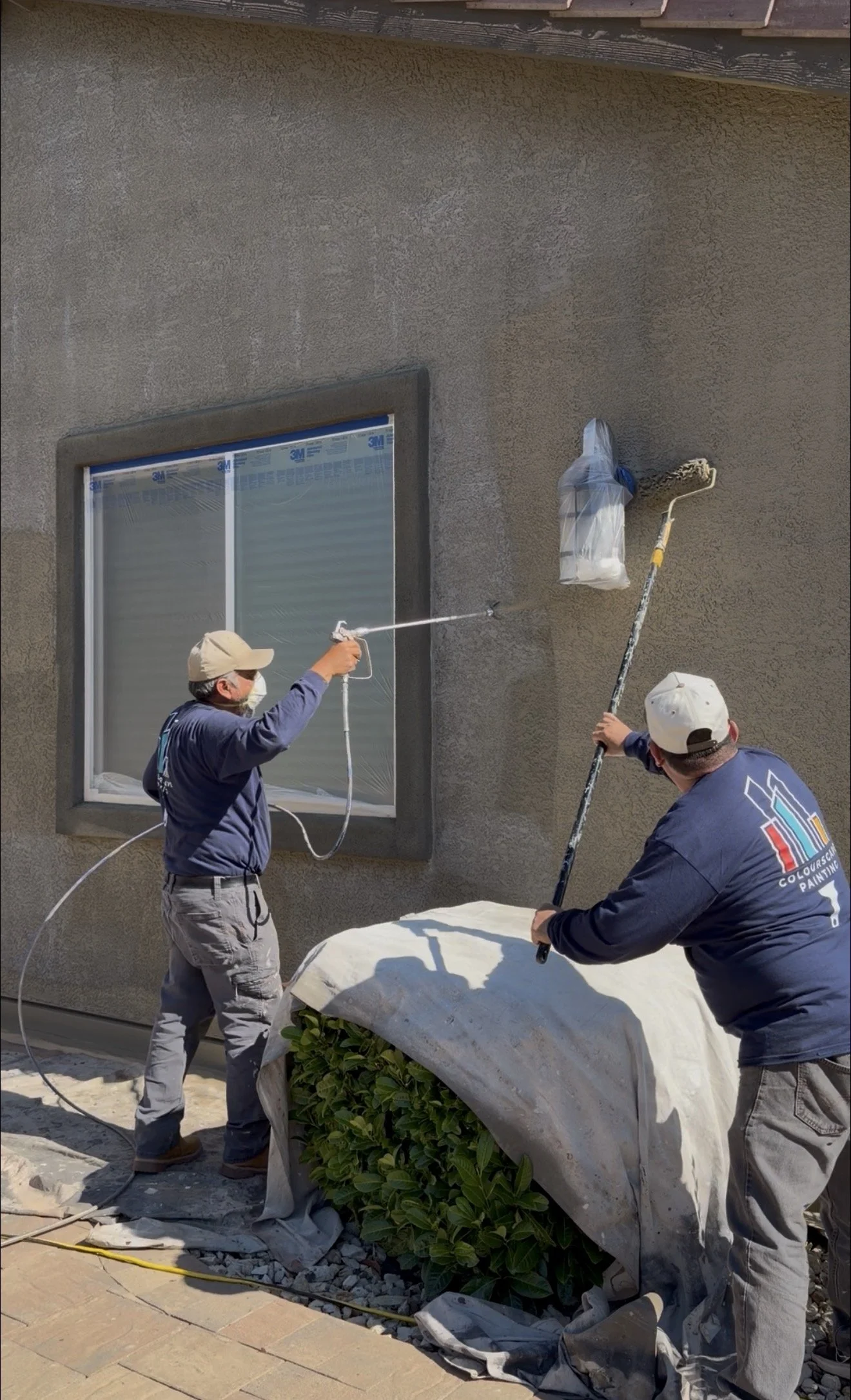
Spray and Backroll
Only right way to apply paint on stucco for a long lasting finish.
This homeowner had already decided he wanted Behr Ultra. We told him what we would spec and why. He wanted Behr. So we used Behr.
That is worth saying out loud, because it is how we work. You get our honest recommendation with the reasoning behind it, in writing. Then it is your house and your money. What does not change is the prep, the coats, or the standard we hold. Behr Ultra is a legitimate 100 percent acrylic exterior product, and applied over stucco that has been washed clean of chalk, patched, sealed and properly primed, it performs. We are not going to shortcut the prep and blame the paint later.
Staying dark, on purpose
He kept the dark color. He liked it, it fit the neighborhood, and changing it would have meant an architectural committee submittal he had no interest in.
That is a fair choice as long as you know what you are signing up for. Dark exteriors in South Reno need a shorter maintenance cycle than light ones. The way you get the most out of a dark color here is film thickness and clean prep. Full spread rate, no stretching material, nothing applied over anything powdery.
We also tell dark-color clients to rinse the south and west elevations once a year with a garden hose and mild detergent. Dust and grit sitting on the film accelerate wear, and a rinse costs nothing.
Working inside a gate
A gated community in South Reno is not the same as an open street. Gate codes arranged ahead of time, not at 7 a.m. on day one. HOA work-hour rules respected. Equipment staged so we are not blocking a neighbor's driveway. Site swept clean at the end of every day, not just at the end of the job. Every stage photographed in CompanyCam so the homeowner can watch progress from their phone whether they are home or not.
Those are not extras. In a neighborhood where everyone knows everyone, that is how we get the next three houses.
What it cost
He got multiple bids. He told us some came in at roughly double our number.
The finished job landed between $10,000 and $13,000. It started lower and grew as we went, because he kept adding work once he saw how the first phase was going. That is the usual pattern on jobs like this. The scope grows when the trust does.
We are not the cheapest bid in Reno and we are not trying to be. We are also not the outfit charging double for the same work. We will tell you exactly what is in the number and why.
How to tell if your stucco is due
Two minutes, do it today:
Pick a south or west facing wall and make sure it is dry.
Wipe it firmly with a dark cloth or your palm.
Look at what comes off.
Clean means you have time. Light dust means start planning. A heavy coating of colored powder means the film is already failing, and every season you wait adds prep cost, because chalking does not stop on its own.
Also look for cracking in the stucco, caulk pulled away from window frames, and body color that reads noticeably different on the north side than the south side. That last one is fade, and it is the clearest sign the film is on its way out.
Getting a straight answer on your house
Colourscape Painting is veteran owned, family run and BBB accredited. We work throughout Reno, Sparks, Verdi, Incline Village and the Nevada side of Lake Tahoe. If your stucco is chalking, we will tell you what it needs, what it does not need, and what it costs, in writing, before anyone touches your house.